|
Course Description
Clarinet Studio at the University of Florida is designed to instill
the knowledge and develop the skills necessary to prepare the student
to pursue a professional career in music. Each course is divided into
three components: lessons, studio class, and clarinet ensemble.
Lessons and studio class are the required components of the course.
Clarinet ensemble is a voluntary component of the course, however each student must register for the
ensemble in order to participate. (Course number: MUN 1460 –
1 credit per semester).
Instructor’s Educational Philosophy
As a teacher, it is my responsibility to offer each student the
opportunity to learn and progress in the art of music. It is my goal
to help students reach their musical potential. It is my desire to
impart in each student my acquired musical knowledge and a lifelong
dedication towards musical excellence. It is also my desire to share
my artistic achievements and professional expertise. I wish to pass on
the musical knowledge and traditions that have been instilled in me
during my years of study and throughout my experiences as a performer,
educator, and human being. It is my intent to nurture musical and
artistic growth through inspirational instruction and a structured,
goal-oriented curriculum. I will endeavor to provide a supportive and
positive learning environment where I can offer constructive criticism
when necessary. I will adhere to the highest artistic standards and
will maintain high expectations of all students regardless of their
background or level of study. I will be realistic in my expectations.
I will strive for open and honest communication with each student in
an atmosphere of trust and mutual respect.
Private Lessons
The weekly lesson curriculum will be structured to address the
fundamental and technical aspects of clarinet performance. Emphasis
will be placed on learning the art of musical interpretation, with
attention being paid to the historical background and stylistic
nuances appropriate to the repertoire being studied. All students will
be instructed in performance technique.
Clarinet Studio Class
The weekly studio class is a series of highly structured masterclasses
covering a wide variety of performance related and pedagogical topics.
Particular emphasis will be placed on instruction and discussion of:
-Reed adjustment
-Solo repertoire
-Orchestral repertoire
-Chamber music repertoire
-Equipment selection
-Instrument maintenance
-Clarinet pedagogy
-Historic recordings
Student presentations will be an integral part of the class as well. Guest lecturers
and performers will be invited to visit the class on a regular basis. The
Clarinet Studio Class takes
place on Monday during 6th period in MUB 142.
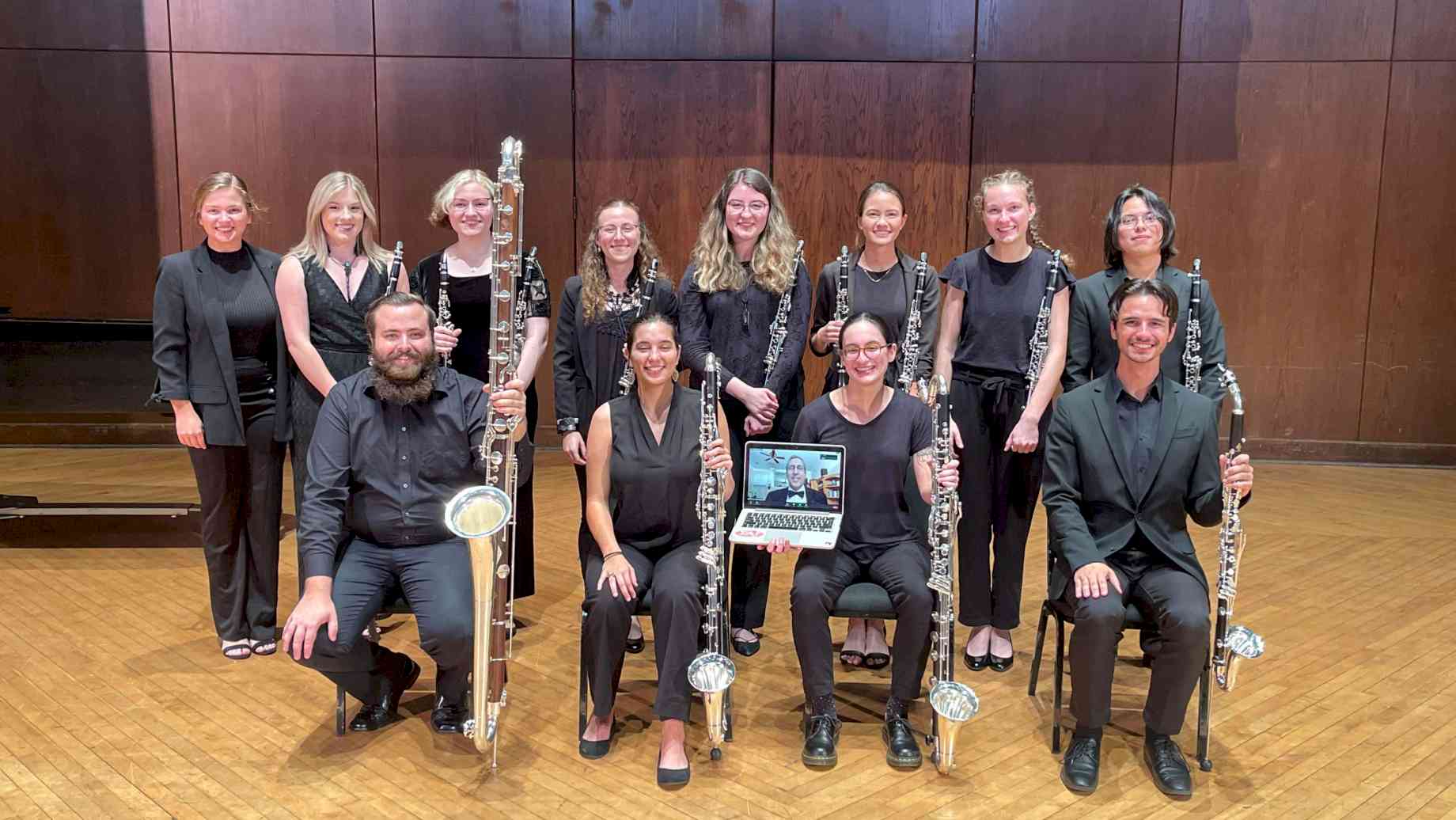
Clarinet Ensemble Class
The weekly clarinet ensemble class is a performance class where a wide variety of
repertoire will be covered. Anyone registered for ensemble credit will be required to
attend. Each student will have the opportunity to perform not only on the B-flat clarinet,
but also on the E-flat soprano clarinet, E-flat alto clarinet, basset
horn, B-flat bass clarinet,
E-flat contra-alto clarinet, and B-flat contrabass clarinet. Emphasis will be placed on
sight-reading and ensemble playing technique. All students are encouraged to contribute
their own musical compositions and arrangements for the ensemble. The ensemble will
perform on School of Music concerts, travel and perform for national, regional
,and local musical events, and will periodically perform free concerts
in schools and for the community. The
class takes place on Wednesday during 6th period in Room 121.
Extra rehearsals will be scheduled in preparation for performances, as
needed.
Course Outline
The instructor will make individual repertoire assignments at the beginning of the
semester. Course content will include:
-Scales
-Articulation exercises
-Etudes and studies
-Orchestral repertoire
-Chamber music
-Transposition studies
-Solo repertoire
-Reed selection and adjustment
-Audition preparation
-Coping with performance anxiety
The lesson sequence will be formatted. Particular attention will be paid to
instruction of practice technique and instituting strategies for overcoming instrumental
deficiencies and difficulties. Each student is expected to work diligently in preparation
for the weekly studio lesson.
Course Objectives
The primary objectives of the Clarinet Studio curriculum will be to strengthen and enhance
the fundamental and technical musical skills of each student and to explore and refine the
art of musical interpretation. Students are encouraged to develop their musicianship
through listening to, researching, reading, and performing all styles of music. Emphasis
will also be directed towards developing a working knowledge of the standard clarinet
literature, including historical significance, form, and style. Students are encouraged to
listen critically to themselves at all times in order to gain independence in musical and
technical problem solving and to consistently improve their performance.
Grading Procedure
Semester grades will be based on the course content learned and the quality of preparation
and performance. A strict point system will be utilized. There are six grading components
that will be taken into account:
1. Lesson preparation
2. Lesson performance
3. Jury grade
4. Studio/area/convocation performance grade
5. Class participation
6. Attendance
Each component will be graded independently and is worth one-sixth (16.66%) of the
total grade. The points awarded by the instructor for each of the six components will be
added together and the total points earned will dictate the grade.
Component points will be awarded as follows:
A = 6 points
B+ = 5 points
B = 4 points
C+ =3 points
C = 2 points
D = 1 point
E = 0 points
Total possible points for the course: 36
The grading scale is as follows:
A: 33 - 36
B+: 29 - 32
B: 24 - 28
C+: 18 - 23
C: 12 - 17
D: 6 - 11
E: 0 - 5
Extra credit can be earned with approval from the
instructor. Additional points can be awarded for research projects,
performing on student recitals, distinguished accomplishments, special
projects undertaken, and service to the clarinet studio.
Grading Components
1) Lesson Preparation: Points will be awarded for excellence in
preparation of the weekly lesson. In order to earn the maximum points
for lesson preparation, all assigned materials must be practiced
diligently and learned for the weekly lessons.
2) Lesson Performance: Points awarded will be based on the performance
level demonstrated during lessons throughout the semester. In order to
earn the maximum points for lesson performance, lessons must be
performed at a continual high level of proficiency during the semester.
3) Jury Grade: Points awarded will be based on an average of the faculty
grades for the jury.
4) Studio/Area/Convocation Performance Grade: The instructor will award
points based on his assessment of the performance.
5) Class Participation: Points will be based on the instructor’s
assessment of the student’s level of involvement during class and
his/her contributions to the studio and commitment to the course.
6) Attendance: Points will be based on adherence to the
attendance/tardiness policy.
Attendance/Tardiness Policy
Attendance will be taken at ALL studio activities. Students are required
to attend all lessons and studio classes. Additionally, students are
required to attend all clarinet studio recitals, area recitals, and any
concert or convocation where a member of the clarinet studio is
performing. Each unexcused absence will result in a deduction of two
points from the attendance component of the grade. If you are unable to
attend a lesson, studio class, clarinet studio recital, area recital,
concert or convocation, you must notify the instructor in person, by
telephone, or by email at least 24 hours before the scheduled activity.
Failure to do so will result in a two-point grade deduction. Lessons
missed due to an unexcused absence will not be made up. The only
exceptions to this policy will be due to an emergency or other extreme
extenuating circumstance and will be at the sole discretion of the
instructor. Each tardiness of more than ten minutes will result in a
one-point grade deduction.
Juries
All students enrolled in the clarinet studio are
required to perform a jury for the Woodwind Area Faculty at the end of
each semester of study. The
jury will consist of a ten minute prepared program.
This program will include a minimum of two repertoire
pieces and three etudes, which have been studied during the current
semester with the studio teacher. You may also prepare two orchestral
excerpts instead of one etude. The repertoire pieces should be of
contrasting styles. Each student will present the jury with two copies
of a printed program, which will include the titles of the selections to
be performed, the names of the composers, and their dates.
In addition, the student will submit a Semester Repertoire
Report, which specifies all materials studied during the current
semester. The student will
perform the selections in program order, however, the faculty may
request the other selections listed on the program at any time during
the performance. Additional requirements will be added for the
Pre-Professional Jury and for recital approval
juries. Please consult the School
of Music Student Handbook for further information.
Recital Performances
All students in the Clarinet Studio are required to perform in a minimum
of one student recital each semester. This includes Convocation
Recitals, Woodwind Area Recitals, and Studio Class Recitals. Assignments
will be made at the beginning of the semester by the instructor as to
which recital category a student will perform in and the repertoire to
be performed. The Woodwind Area Faculty will determine performance
dates. It is the student’s responsibility to find an
accompanist and schedule adequate rehearsal time. Lessons with
accompaniment should take place a minimum of twice before the recital.
Solo recitals are required of music majors in the junior and senior
years as follows:
Junior: Performance Majors and Music Education Majors
Senior: Performance Majors and Music Education Majors who are seeking a Certificate in
Performance
Written program notes are required for all solo recitals.
Large Ensemble Participation
Each student in the Clarinet Studio is required to enroll and participate in one of the
School of Music major performing ensembles. Placement will be made through competitive
auditions at the beginning of each semester.
Studio Website
The University of Florida Clarinet Studio Website is designed as an educational forum and
communication tool. All students are encouraged to contribute their ideas and creativity
to the site. The instructor will consider any relevant articles for inclusion on the site.
All students are invited to share in the responsibilities of maintaining the website. The
instructor will make assignments at the beginning of each semester regarding individual
responsibilities for site maintenance. The site will be updated a minimum of twice during
the semester. The address of the website is http://www.arts.ufl.edu/music/clarinet.
Studio Listserve
The University of Florida Clarinet Studio maintains a listserve
for informational exchange between Professor Estrin and members of the
studio. The listserve is available strictly for studio members to
communicate studio business and other pertinent information. All users
are expected to adhere to acceptable codes of conduct. The listserve
address is: CLARSTUDIO-L@lists.ufl.edu
Instructor’s Expectations
Each student is required to practice daily and learn all assigned
materials for the weekly lesson. This means daily structured practice
sessions. Each student is expected to work diligently towards a mastery
of all the scales and arpeggios including:
-Major
-Minor
-Chromatic
-Wholetone
-Pentatonic
-Thirds
-Dominant sevenths
-Diminished sevenths
-Others as assigned by the instructor
All students are expected to warm-up before their
lesson. Performance repertory should be learned well in
advance of scheduled concert dates. All course materials required and/or
assigned by the instructor are expected to be purchased in a timely
manner. Instruments are expected to be maintained properly and in
excellent mechanical condition. The instructor also expects a positive
and enthusiastic attitude towards the course and its related activities.
All students in the Clarinet Studio are expected to be supportive,
respectful and helpful to other members of the studio.
Academic Honesty
All students are expected to adhere to the University of Florida Honor
Code. This includes the Student Honor Code Oath and Academic Honesty
Guidelines.
The Honor Code Oath: “We, the members of the University of
Florida community, pledge to hold ourselves and our peers to the highest standards of
honesty and integrity.” On all work submitted for credit by students at the University of
Florida, the following pledge is either required or implied: “On my honor, I have neither given nor
received unauthorized aid in doing this assignment.”
Students
Requesting Accommodations due to Disabilities
Students requesting classroom accommodation must first register
with the Dean of Students Office. The Dean of Students Office will
provide documentation to the student who must then provide this
documentation to the Instructor when requesting accommodation.
Available Support Services
Academic and personal counseling is available to all students during
the regularly scheduled office hours and by appointment.
Student Confidentiality
Student records are confidential. Only information designated
“UF directory information” may be released without your written
consent. Please see University Regulation 6C1-4.007 for a list of
information designated as “UF directory information”.
UF views each student as the primary contact for all
communication. If your parents contact me about your grade,
attendance, or any information that is not “UF directory
information”, I will ask them to contact you. You may 1)
provide the information your parents seek directly to them or 2)
contact the University Registrar’s Office for additional
information. www.registrar.ufl.edu/ferpahub.html
Required Materials
C. Baermann – Method for Clarinet, Third Division (Carl Fischer or
David Hite edition)
C. Rose – 40 Studies for Clarinet, Books 1&2 (Carl Fischer
edition)
R. Kell – 17 Staccato Studies (International edition)
P. Hadcock – The Working Clarinetist (Roncorp)
R. McGinnis – Orchestral Studies, Volumes 1&2 (International
edition)
P. Bona – Method for Rhythmical Articulation (Carl Fischer edition)
C. Ammer – The A to Z of Foreign Musical Terms (ECS Publishing)
Metronome
Tuner
Jeweler's Screwdriver
Reed Supplies:
Reed Clipper (Cordier)
Glass Plaque
Reed Knife
Reed Rush
Wet/Dry Sandpaper (grades 320, 400 & 600)
Additional Suggested Materials
C. Rose – 32 Etudes for Clarinet (Carl Fischer edition)
N. Heim – The Development of the Altissimo Register for Clarinet (Kendor
Music)
R. Stark – Practical Staccato School, Part III (Anton J.
Benjamin)
D. Bonade – A Clarinetist's Compendium (Leblanc Educational Series)
K. Opperman – Handbook for Making and Adjusting Single Reeds
(Chappell)
J. Brymer – Clarinet (Schirmer Books)
T. Ridenour – Clarinet Fingerings: A Comprehensive Guide for the
Performer and Educator (Leblanc Educational Publications)
Other excellent reading, research, and listening materials are
available in the Clarinet Studio and Music Library. |